
What are manuals and guidelines?
Manuals and guidelines are the most traditional form of design standards. Guidelines or standards are developed for local streets that permit or specify widths, street geometry, utility placement, and provision of bicycle and pedestrian facilities that promote walkable, human-scaled communities. The MDT Road Design and Traffic Engineering Manuals, for example, contain the agency's road design and traffic engineering processes, describe the practices followed by the department during highway project development, and outline detailed information about basic design controls, geometrics, and design criteria.
In most states, the design manual is based upon recommendations in the AASHTO Policy on Geometric Design of Highways and Streets, commonly referred to as the "Green Book." The Green Book is not a design manual but rather a series of recommended roadway design parameters. Context Sensitive Solutions (CSS), formerly known as Context Sensitive Design (CSD) is an evolving approach to developing and applying design standards that support local goals for community development and roadway character. CSS guidelines, which complement but do not replace the Green Book, have enriched several state and local roadway design resources and procedures such as the MDT Context Sensitive Solutions Guide.
Manuals and guidelines are not specific to roadway design. These resources also exist for transit, bikes, pedestrians, railroad crossings, and other elements of community planning and design. More conceptual guidelines are useful for communities when implemented correctly, as they can influence transportation and land use planning and policy decisions. For instance, an agreed-up set of guidelines could stress the importance of incorporating pedestrian and bicycle features in local maintenance projects.
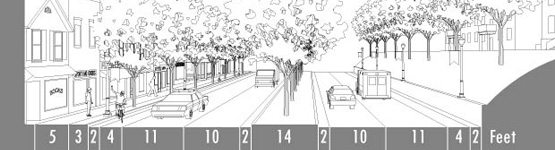
Regarding Context Sensitive Solutions and Complete Streets, localities can write guidelines for adopting policies and practices. These can be additions to the design manuals used by the Departments of Transportation or Public Works, including preferred street sections and other alternative design specifications that equally address the safety and comfort of all road users.
Who can implement it?
The most widely accepted design manuals are usually written by highway and traffic engineers through national engineering organizations, like the American Association of State Highway and Transportation Officials (AASHTO), the Institute of Transportation Engineers (ITE), and the Federal Highway Administration (FHWA).
State agencies also compose and implement their own roadway design manuals, which are usually more specific than those published by federal organizations. These contain detailed standards used by highway designers.
In some instances, individual localities have published their own design manuals, like the City of Milwaukee, WI. The state of Wisconsin has its own documents for engineering and construction, like the Facilities Development Manual and Standard Specifications. The City of Milwaukee's Transportation Design Manual further provides street design requirements.
Individual localities are perhaps best positioned to incorporate Complete Streets principles into local design guidelines. Throughout the country, local jurisdictions have implemented Complete Streets policies and modified the design guidelines for their community. (see www.completestreets.org for an inventory of Complete Streets policies).
Through a study funded by the Virginia DOT Rural Planning Grant program, the Thomas Jefferson Planning District Commission in central Virginia produced the Design Manual for Small Towns (www.tjpdc.org), a practical "how-to" handbook for residents of small towns, their elected officials, and the local government staff who support them, providing strategies for preserving local character when making transportation and land use decisions.
What are the keys to success and potential pitfalls?
To ensure implementation results in a streamlined production of results, all different governmental agencies involved in approval, construction, and maintenance of development and road projects must be familiar with the design standards. These agencies must also coordinate during the approval process to ensure that all departments (planning and zoning, neighborhood development, traffic operations, etc) are enforcing design standards in the development approval process. Similarly, the maintenance of roads can incorporate design standards in a piecemeal fashion, smoothing the financial strain of updating the network all at once.
The effectiveness of a set of design guidelines is largely dependent upon the technical details of the requirements. Implementation of technically inefficient design can lead to or exacerbate safety, congestion, capacity, and mobility issues -- issues the standards were originally trying to address. Numerous skilled and experienced professionals with a diverse array of perspectives (traffic operations engineers, pavement materials engineers, pedestrian enthusiasts, transit planners, roadway design engineers, etc.) must be involved to ensure design standards will be effective.
Where has this strategy been applied?
Examples in Montana
- MDT has developed and posted MDT's Road Design and Traffic Engineering Manuals on its web site containing the agency's road design and traffic engineering processes, and describing the design and traffic engineering practices followed by the Department during the development of highway projects. Among other items, these manuals outline detailed information about basic design controls, geometrics, and design criteria for all classes of roads on the state highway system. In addition, MDT has incorporated Geometric Design Standards for Urban and Developed Areas into its road design manual for use in construction of local roads and streets. The statutory city and county design standards committee has adopted these publications for use on all public roads, classified as collector arterial or higher throughout Montana.
- In October 2003, MDT issued Management Memorandum Number ENG-03-01, Context Sensitive Solutions that outlines the agency's policy regarding the incorporation of context sensitive solutions into project development activities. Issues sometimes arise when state highways pass through communities and MDT's geometric design criteria conflict with local desires. MDT has inherent obligations to meet geometric requirements and capacity needs for principal arterials, minor arterials, and collectors on the state road system. Some communities in the State have asked for the consideration of roadway typical sections with narrower lane widths and other streetscape amenities that vary from the criteria listed in MDT's Road Design Manual. MDT has made a commitment to incorporate context sensitive solutions into its project development activities. Toward this end, the memorandum is intended to:
- Reinforce MDT's commitment to work with communities and local stakeholders to assure that MDT transportation facilities meet their needs, as well as the needs of the traveling public;
- Establish that pursuing context-sensitive solutions is to be an integral part of all phases of all projects and become a part of MDT's organizational culture; and
- Provide guidance to staff about considering context-sensitive design solutions when making decisions about nominating projects, evaluating needs, prioritizing, designing, constructing, and maintaining highway projects.
Examples outside of Montana
- The City of San Diego has a street design manual that provides standards and suggestions for streets based on functional classification, pedestrian facilities and lighting, among other design elements. This manual is consistent with the area's general plan, transit-oriented development guidelines and land development code, helping to reinforce the city's planning principles.
- The Massachusetts Department of Transportation undertook a major rewrite of its design manual (the Project Design and Development Guide), incorporating complete streets principles throughout - and won several national awards for their effort.
Case studies
How can I get started?
The first step in any design manual should be research. Becoming familiar with the AASHTO Green Book is crucial, as this design resource thoroughly explains all aspects of roadway design.
Most jurisdictions follow the state DOT's design manual. Local jurisdictions may research other design manuals to find the design standards that are most relevant to their locality, and integrate these into their own design guidelines. The National Complete Streets coalition has information available to help advocates for pedestrian, bicycle and transit safety influence decision-makers for more comprehensive design policies. Workshops are also available for local and regional stakeholders to learn more about design policy and its effects.
Where can I get more information?
- A Policy on Geometric Design of Highways and Streets. AASHTO is the accepted leader and the backbone of most roadway design standards. The Green Book provides references on all elements of roadway design.
- National Complete Streets Coalition
- Reid Ewing. Pedestrian- and Transit-Friendly Design: A Primer for Smart Growth
- MDT Context Sensitive Solutions Resource Page
- Montana Complete Streets Toolkit