
What is multimodal transportation infrastructure?
Multimodal transportation systems provide users with a variety of modal options, which is particularly relevant for those who are unable to drive, would prefer not to drive, or cannot afford the costs associated with automobile ownership. In urban locations, multimodal transportation systems help to reduce the stress often caused on roadways by over-reliance on private vehicular access. Non-vehicular transportation is also increasingly promoted as a means for engaging in physical activity, in response to the rising rate of obesity and obesity-related diseases such as diabetes.
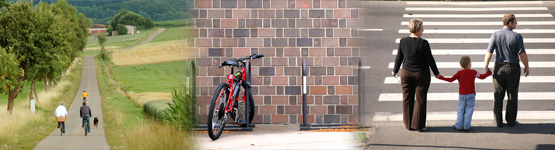
Continuous networks of sidewalks, bicycle facilities, and trails are essential components of a multimodal transportation system. Sidewalks that tend to be the most inviting are ones that are buffered from vehicular traffic (by parked cars, trees, or lateral distance), wide enough to accommodate all users (usually 8' width in commercial areas is recommended), and that provide direct access to building entrances. Bicycle lanes or paved shoulders are necessary on high volume or high speed roads where it is uncomfortable and unsafe for bicyclists to ride in the lane with vehicular traffic. Bicycle lanes should have a minimum width of 5 feet. Paved shoulders should have a minimum width of 4 feet to accommodate bicyclists, however where 4 feet cannot be achieved, any additional shoulder is better than none at all. Multi-use trails should be at least 10' wide and are safest when at-grade crossings with streets and driveways can be minimized.
Sidewalks should be supported by curb ramps at intersections and driveways, and crosswalks and pedestrian signals at intersections, as required by federal ADA guidelines. In addition to bike lanes, bike racks or lockers encourage bicycle activity because of the safety of storing bikes. Bike racks on buses and other transit facilities for bicyclist encourage the use of bicycle transportation for longer trips. For roads that do not have enough extra-width for a bike lane, wide outside lanes and "Share the road" signs give bicyclists room on the side of a road and alert drivers to the possible presence of cyclists.
In rural areas, multi-use paths provide pedestrians and bicyclists with a safe place to travel, instead of alongside a high-speed curvy road with poor sight distance. Pedestrian trails in lower density areas can enhance the quality of life and provide recreational space for joggers and dog-walkers.
Who can implement it?
Localities are most often responsible for the construction of sidewalks. It is common to require these facilities to be provided on-site as a condition for development, with additional off-site facilities supported by general funds, tax-increment financing, impact fees, grants, or parking fees. Local governments can also use these mechanisms for bicycle facilities as well.
In some cities, each individual property owner is responsible for the maintenance of the sidewalk abutting their property line. Montana Code 7-15-4125 states, "The city or town council has power to require the owner of a sidewalk, house, or other structure which is dangerous to passers-by to repair or remove the same after notice." Ultimately, localities are responsible for identifying pedestrian facilities in need of repair, and should strive to create a thoroughly connected, ADA compliant sidewalk system.
Bicycle lanes are also the responsibility of the city. Depending on the functional classification of a roadway, the state department of transportation may also play a significant role in installing bike lanes. Local governments can require bike lanes to be installed by developers as part of the development approval process. In some instances, cities have required developers to provide easements for the right-of-way for future bike lane construction.
Funds for pedestrian or bicycling infrastructure projects may be obtained through state or national grants and initiatives, such as the Safe Routes to School program. Other grant programs include Transportation Enhancements, New Starts and Small Starts, Rural Public Transportation, and Job Access and Reverse Commute.
What are the keys to success and potential pitfalls?
The most crucial element of sidewalks and bike lanes is connectivity to the multimodal transportation system. A quarter-mile stretch of bike lane is a great first step, but for trips where the origin or destination is outside of that quarter-mile, cyclists would be placed back into danger. Sidewalks should connect to transit stops and provide a safe place to wait for the bus.
Creating a community-wide initiative will spark interest in issues of pedestrian safety and can help raise awareness. A well-developed policy for sidewalks or bike lanes can require construction of facilities and help make things happen.
Smooth surfaces of sidewalks are important, especially for older persons and persons with disabilities. Maintenance is key to encouraging walking as a viable means of transportation.
Where has this strategy been applied?
Examples in Montana
- The Greater Bozeman Area Transportation Plan outlines locations for new roads, bike paths, sidewalks and other facilities to accommodate the demands of future traffic. The public input process involved over 3,200 area residents, resulting in a plan that fully integrates non-motorized considerations and recommendations in all chapters of the Transportation Plan. The plan recommends 19 sidewalk projects, 14 pedestrian intersection improvements, 50 bike-lane projects, 22 expanded road-shoulder projects and 24 shared-use path projects. In addition to physical improvements, the Plan includes Complete Streets principles and guidelines, education and encouragement programs, and updated roadway typical sections that will ensure bicycle and pedestrian accommodation in any future roadway project. This adopted plan, with recent improvements, puts Bozeman in good position for the League of American Bicyclists' 'Bicycle Friendly Community' status.
Examples outside of Montana
- WALKArlington is an initiative of Arlington County, VA partnering with citizens, businesses and County departments to increase walkability, improve quality of life, and reduce traffic congestion. The initiative has resulted in design guidelines for pedestrians, new sidewalk design standards and specifications, and numerous programs to promote traffic calming, transportation management and other incentives to increase walkability.
- New York City has produced a Street Design Manual that specifies geometric street treatments, materials, lighting and furniture to focus on the transportation and safety of people, not just automobiles. The manual promises to simplify the design process and reduce the costs for city agencies, urban planners, developers and community groups.
- The Florida Department of Transportation produced the Quality/Level of Service Handbook to elevate walking as a legitimate mode of transportation by creating a way to assess the quality of service of the pedestrian environment, similar to the traditional level of service for motorized vehicles.
- Redmond, WA has incorporated language into their Municipal Code (Section 12.06) stating, "The City of Redmond will plan for, design and construct all new transportation projects to provide appropriate accommodation for bicyclists, pedestrians, transit users and persons of all abilities in comprehensive and connected networks."
Case studies
How can I get started?
The first step in implementing multimodal transportation systems is typically to develop a plan for each multimodal system with cost estimates and a prioritized list of improvements. At that point, projects can either be implemented through the local capital improvement process or by developers as a condition of development approval. Comprehensive plans typically provide the framework for the development of multimodal transportation infrastructure and management programs. Including pedestrian and bicycle goals, initiatives and projects into regional long-range transportation plans can further propel these projects into action.
Transportation and land use planners typically collaborate on the development and implementation of multimodal transportation infrastructure and management programs. Implementation often requires coordination at the regional level. The public is often consulted during the planning stages to help identify system needs and priorities.
Where can I get more information?
- National Complete Streets Coalition
- Safe Routes To School
- Association of Bicycle and Pedestrian Professionals
- "Sidewalk Planning and Policies in Small Cities." Jennifer Evans-Cowley. June 2006. Journal of Urban Planning and Development, Volume 132 Issue 2, pg 71-75
- Recommended Guidelines/Priorities for Sidewalks and Walkways
- Guide for the Development of Bicycle Facilities. AASHTO. 1999.
- US Access Board Public Rights of Way
- Federal Transit Administration Grant Programs
- FHWA Bicycle/Pedestrian