
What is an Urban Transportation District?
Urban Transportation Districts in Montana are created to "supply transportation services and facilities to district residents and other persons." A UTD is structured similar to a Special Improvement District (SID) with bonds backed by local government issued to cover the cost of a proposed transportation improvement. Revenue to pay for the bonds is raised through assessments against property owners in the designated district.
Urban transportation districts serve the function of creating a steady funding source for local governments to finance a variety of transportation services and facilities. One significant advantage of the UTD is the capability to bring several municipalities and counties together in funding and operating a transit system. Examples of successful urban transportation districts in Montana such as Great Falls Transit and Missoula (Mountain Line) prove that financing districts can provide a transit service that has a broader local-regional scope.
Who can implement it?
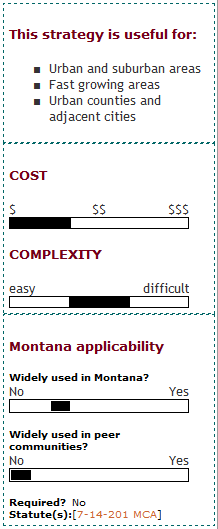
MCA 7-14-201 provides counties the authority to establish Urban Transportation Districts (UTDs), provided that residents within the proposed district vote in favor of the measure. Like SIDs and Rural Special Improvement Districts (RSID), the UTD has the flexibility to extend across city and county boundaries.
The Urban Transportation District is administered by a transportation board, which is responsible for all of its operations, including planning and budgeting. Local governments may levy taxes and issue bonds to fund the proposed improvements to facilities and services. The locality(ies) conduct a public hearing and establish the makeup of the Board's membership (including its status as an elected or appointed body).
What are the keys to success and potential pitfalls?
Establish Logical District Boundaries: Urban transportation districts (UTDs) should have boundaries that are logical and easily communicated to property owners and registered electors within the proposed district because their formation is subject to voter approval. UTD boundaries need to avoid the creation of "holes" or areas where the district would not have operational or maintenance responsibilities. Special assessment districts like UTDs can only be used to finance facilities that provide benefits to the district. Therefore if the district is intended to finance facilities that result in community-wide benefits, the district must be established to include the entire jurisdiction (city or county).
Identify and Communicate Transportation Needs: Developing a comprehensive understanding of the travel patterns, mobility needs, and existing services and facilities is essential to establishing the purpose and need for creating a UTD. Proponents of UTDs need to convey this information to local decision makers and those within the district to help ensure its successful formation and future operation.
Coordinate with Stakeholders and Potential Transportation Partners: Coordination efforts can help foster innovative solutions to meeting the demand for transportation services within the UTD. Local governments, transit operators, city and county transportation and human services agencies, health care providers, economic development agencies, large employers, and others are all potential transportation partners. Understanding their needs is essential to providing efficient and effective transportation services and facilities. Ongoing coordination efforts can help gauge the overall effectiveness of activities by the district and help to identify changing transportation needs.
Revenue Considerations: The primary method of collecting revenue within the transportation district is through a tax levied upon all property within the district sufficient to operate the district and meet the amount of funding requested by the transportation board. Once in place, the revenue collection process occurs through annual tax assessments to property owners. A transportation district may borrow money by issuing general obligation and/or revenue bonds to provide funds for the district. However, Montana code states the amount of bonds issued to provide funds for the district and outstanding at any time may not exceed 1.51% of the total assessed value of taxable property within the district.
Where has this strategy been applied?
Examples in Montana
- Great Falls Transit Urban Transportation District: The Great Falls UTD has been serving the City of Great Falls and Black Eagle since 1982. As of the 2010 US Census the City of Great Falls has a population of 58,754 with an urbanized area of 19.5 square miles. According to the National Transit Database (NTD), Great Falls Transit serves a population of 63,506 and has a service area of 20 square miles. The transit service provides both fixed-route and complementary paratransit service with a peak service of 13 fixed-route and 7 paratransit vehicles. As a UTD, Great Falls Transit Board of Directors is made up of three elected members, one City appointee, and one County appointee. The UTD has the ability to generate revenue and receive Federal Transit Administration funds as a direct recipient. Having a dedicated tax enables the transit agency to perform long-range planning since it can accurately forecast its revenue into the future. Having a constant source of local revenue also improves the transit agency's chances of receiving Federal and state funding since these entities can be assured of local match money being available.
- The Missoula Urban Transportation District or Mountain Line, began operating in 1977 with three used buses on four routes. Since then the agency has grown to operating 6 days per week and now has some 29 buses operating on 14 routes. In 2012, Mountain Line continued to break ridership records with 943,809 rides provided. A seven-member board oversees the operation, improvement, maintenance, and administration of the Transportation District, makes policies for the District, and provides oversight of the District for the benefit of the citizens within the District.
- The Dawson County Urban Transportation District provides transportation service for aged and disabled persons as well as all persons requesting to receive service, operating with 12 passengers buses Monday-Friday 7:30-5:00. Dawson County Transit provides transportation service to those individuals needing medical services and transportation for shopping, employment, education, and to attend social and recreational activities
Examples outside of Montana
The terminology "urban transportation district" may be fairly unique to Montana; however there are several similar types of districts outside of Montana:
- Multimodal Transportation Districts in Florida
- Regional Transportation Districts - Denver area, Vermont
How can I get started?
The creation of an urban transportation district is initiated by a petition of at least 20 percent of the registered voters within the proposed district. A formal public hearing must be held; after which the creation of the district is put to a vote. The county commissioners determine whether a special election is necessary, or if a vote can take place at the next general election.