What is a charrette?
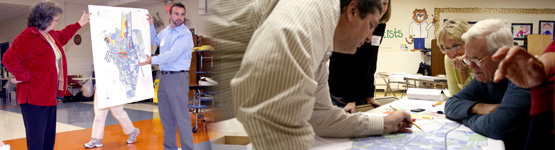
Charrettes are multiday, creative sessions where teams concentrate on specific design problems and present solutions. Charrettes have been successfully applied to develop plans covering transportation and land use, as well as help determine infrastructure needs and desires. The charrette process is most efficient at solving controversial and complicated planning problems. A charrette provides a unique opportunity to bring together all stake-holders and voices to find a solution that has support from all parties.
Who can implement it?
Charrettes are usually sponsored by public agencies, private developers, or non-governmental organizations. Regional or local planning departments can use charrettes for most any type of planning or urban design projects.
What are the keys to success and potential pitfalls?
Preparation: Because charrettes are used to achieve a product in only a few days, all necessary data must be gathered before the charrette begins. This data should influence the charrette agenda to ensure the most valuable use of time.
Collaboration: Collaboration between the sponsoring organization, the facilitating organization, the decision-makers, and those who will be affected is essential early in the process. All parties should be assured that their input will have an impact on the final outcome. "True collaboration requires that participants are asked for their input before the design work begins to let them know that their contributions will have an impact on the outcome. When people are involved early in the design and creation of a plan they will support the results." - The Charrette Handbook
Unsettled Political Environments: If all parties cannot agree to participate openly, the charrette may not be successful in finding a true solution... Strong political leadership may be necessary to keep the project moving forward.
Communication: Frequent communication between all participants is crucial in finding a solution.
Where has this strategy been applied?
Examples in Montana
- The West Broadway Corridor, Missoula Community Vision Plan is the product of the West Broadway Corridor Charrette, an intensive community-based planning process that began in October 2006 and concluded in May 2007. The plan outlines a twenty-year vision for West Broadway Corridor and was achieved through the active participation of more than 1000 Missoula residents. The primary goal of this planning effort was to conduct a charrette that addressed long-term needs and a vision for land use, economic development, vehicular movement and access, and increased pedestrian and bicycle safety for the West Broadway Corridor. Initially, the community was conflicted over a reconfiguration of a portion of West Broadway that reduced the number of lanes on the roadway from four to three. While the impetus for a community charrette was controversy, the result of the planning process was a cohesive community vision for the West Broadway Corridor that addresses land uses, built form, public spaces, and transportation. The community's vision for West Broadway will be accomplished through a combination of public and private redevelopment and improvement efforts like streetscape and roadway improvements, access management, parking solutions, affordable housing, storefront improvements, and changes to existing regulations. The Community Vision Plan summarizes the results of the community charrette, all related community workshops, and implementation strategies for making changes in the corridor.
Examples outside of Montana
- The charrette process was successfully used by Teton County, Wyoming Planning and Development Department as part of their Mapping for the Millennium effort, which focused on the redesign of several important transportation corridors in the county. The charrette process used the stakeholder interviews results to provide a diversity of opinions and viewpoints. Each charrette concluded with a pin up session where the design alternative was displayed for public comment and response. After the charrette, comments and concerns could be sent directly to the planning and development department web site.
- In Miami-Dade County, FL, 100 community members gathered to produce a master plan for Downtown Kendall in one week, which was eventually approved by the Board of County Commissioners.
- Bedford Avenue in Nashville, TN, is an example of a residential avenue where land values and market pressures were causing residents and developers to argue over the functionality of the street. After a three-day charrette, members of the community were able to agree on a design plan for the area that established a direction for the neighborhood, and a zoning overlay as a way to implement the plan.
- US30 Master Plan Charrette, Westmoreland County PA
- The Plan for Central Hercules, Hercules, CA
- Pleasant Hill BART Station, Walnut Creek, CA
Case studies
How can I get started?
Before a successful charrette can be held, there's need for preparation. This first phase of getting "charrette-ready" can last anywhere from six weeks to nine months, and includes research and education on the site issues and arranging charrette logistics. Specifically, it is important to review any existing plans and programs related to the project, collect and catalog background information, prepare base maps for use in the charrette, and begin to identify issues and goals.
Another important task prior to conducting a charrette is to identify a diverse group of local citizens that can serve as the coordinators and facilitators of the process. From this group of citizens a steering committee should be formed who will determine the primary focus of the charrette and handle the logistics. It is suggested that the steering committee work with the charrette facilitator to identify a preliminary set of issues to be addressed during the charrette.
The actual charrette workshop is the most visible aspect of the process. To ensure that the charrette runs smoothly, it is important to coordinate all meeting logistics in advance. This includes finding an appropriate date and location where the charrette team can work for the duration of the charrette, establishing the dates, times, and location of charrette workshops, arranging meals and accommodations for the charrette team if they are from out of town, deciding on the materials and supplies needed, and any items needed for formal presentations.