Study Focus
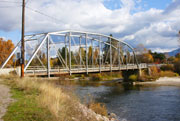
The Montana Department of Transportation (MDT), in partnership with Missoula County, conducted the Maclay Bridge Planning Study. The Maclay Bridge crosses the Bitterroot River approximately 2.75 miles west of Reserve Street via North Avenue (study vicinity map). North Avenue connects to the existing bridge as the eastern approach, and River Pines Road serves as its western approach.
Final Planning Study Report
Final Report
Appendix 1: Consultation, Coordination, and Public Involvement
Appendix 2: Environmental Scan
Appendix 3: Planning Study Documentation
The purpose of the Study was to identify feasible improvement options to address the needs and objectives defined by the community, study partners, and resource agencies. The Study examined geometric characteristics, the bridge's condition, crash history, and existing and projected operational characteristics. Existing and projected physical constraints, land uses, and environmental resources were also analyzed.
The Study identified a wide array of potential improvement options to address facility needs for the bridge and associated roadway, over the planning horizon (year 2040). In addition to identifying possible improvements to the roadway and corresponding alignment, improvement options were identified that included short-term spot improvements, rehabilitation of the existing bridge, replacement of the existing bridge on its current alignment, and replacement of the existing bridge at a new location. The Study was completed at the end of March 2013.
The study process followed the Montana Business Process to Link Planning Studies and NEPA/MEPA Reviews, which requires extensive community outreach and coordination with other partnering agencies.
Issues that were identified include, but were not limited to, the following:
- Sufficiency of the existing bridge to accommodate fire trucks and other heavy vehicle loads;
- Existing bridge approach alignment;
- Existing bridge/road widths;
- Lack of pedestrian and bicycle facilities;
- Safety;
- Parking;
- Future land use considerations;
- Future traffic increases;
- Noise considerations;
- Maintenance;
- Sensitivity to the adjacent land uses (residences, schools, aesthetics, etc.);
- Fisheries habitat and connectivity;
- Wetlands;
- Cost of improvements/project funding; and
- Transparency in the study process.
Previous Planning Efforts
In 1994, the Maclay Bridge Site Selection Study Environmental Assessment (EA) was completed to define the purpose and need for a project at the Maclay Bridge, identify potential alternatives, and assess impacts of the various alternatives identified to address the project's purpose and need. A total of 16 alternatives were evaluated in the EA. This includes the "No Build" alternative, two alternatives that included bridge rehabilitation or bridge replacement (one-lane structure) at its current location, and numerous alternatives that would provide a new bridge elsewhere. Through a screening process, four alternatives were advanced for further consideration (which included the No Build alternative), and a "Preferred Alternative" was identified. The preferred alternative was described in the EA as follows:
"A new two-lane (one lane for each direction of traffic) bridge constructed over the Bitterroot River which connects River Pines Road on the west side to South Avenue West on the east side. The Preferred Alternative includes increasing the number of lanes on the bridge from one lane (existing) to two lanes (proposed). The bridge cross section includes adequate shoulders for bicycle travel and a separated pedestrian walkway."
Upon completion of the 1994 EA, a Finding of No Significant Impact (FONSI) was not issued by the agencies with oversight. Accordingly, a project (or projects) for implementing the preferred alternative contained in the EA was never developed.
Eighteen years after the completion of the Maclay Bridge EA, minor maintenance activities have been performed on the bridge at various times. However, many of the underlying issues that were identified as deficiencies in the 1994 EA remain. This is coupled with the community's heightened interest in transportation-related planning at this location. Both have resulted in the need for this high level, pre-NEPA/MEPA planning effort (refer to the Frequently Asked Questions portion of this website for definition of pre-NEPA/MEPA).