|
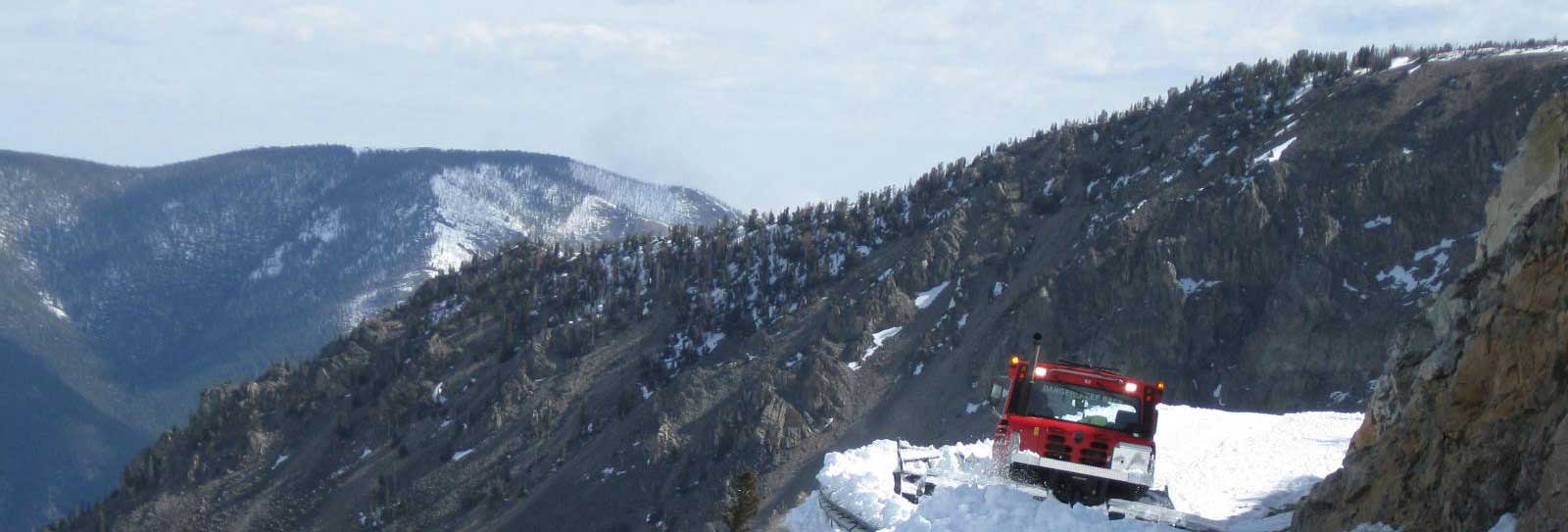
WINTER MAINTENANCE - PLOWS AND DE-ICERHow does MDT prepare for the snow and ice season?This winter, MDT will have approximately 900 trained maintenance personnel working to clear Montana's 25,000 lane miles of highway of ice, slush and snow. These employees will use a variety of winter maintenance vehicles including; snowplows, pre-wetters, spreaders, loaders and rotary snowplows. If a snow storm covers the entire state, the miles required to plow the whole system equates to 2 times around the earth and will be accomplished within 24 hours! During the year maintenance personnel prepare for the snow season by stockpiling necessary supplies. In the fall, the same trucks that have been used during the summer for stockpiling, patching and other maintenance operations are equipped with snowplows. Employees also receive training to operate new equipment and safety procedures. How does MDT decide which roads to clear first? MDT considers these factors for clearing roads in the state highway system:
Interstates and roads that have the highest volume of traffic are cleared first. Workers continue to clear roads with top priority placed on the most-traveled roads down to areas with lower volumes of traffic. Some routes, because of concerns for public safety, high difficulty and cost of winter maintenance, may be closed for short durations until manpower and equipment resources are available for snow removal. Materials Used for Winter Maintenance What is magnesium chloride?
Magnesium chloride works like anti-freeze by lowering the freezing temperature of water and preventing ice from forming a strong bond to the road. It helps keep roads from becoming slick, improves safety and reduces accidents. Why do workers spray liquid onto the roadways before a big storm arrives?
"Colorado Department of Transportation (CDOT) has completed a three-year study into the effects of magnesium chloride on the roadside environment and has found that the product does not significantly harm aquatic or plant life. In fact, the sand and salt mix used in the past can be more damaging to aquatic life -- with the large amounts of silt that wash into the streams -- and to plant life. Liquid de-icers or anti-icers are highly diluted in their usage and are even more diluted when they leave the roadway, mixing with melting water on the highway. The products are virtually undetectable within just a few feet of the roadway. The product does not add air pollutants to the environment and improves air quality by offsetting usage of sanding material. What's more, research into the use of liquid anti-icers and de-icers indicates that they have less negative impact on highway bridge decks, trees and vegetation, and water supply than any other method of winter road treatment utilized in the past. Liquid anti-icers and de-icers are the best products available for protecting many environmental resources." Montana has not done a traffic safety benefit study, however, according to the Colorado Department of Transportation (CDOT), snow, ice and slush related accidents have also been drastically reduced statewide since the winter of 1995/1996 when CDOT began widely using liquid anti-icers and de-icers. Such reductions include a 76% reduction on I-70 west of Glenwood Springs in South Canyon, a 53% reduction on I-70 in the Vail area, a 89% reduction on SH 82 near Basalt, a 53% reduction on I-25 at the Mousetrap and a 64% reduction on I-70 at the Mousetrap. How is magnesium chloride used?
De-icing: The liquid is applied to remove a thin layer of snow-pack or ice already on the road. It can be very effective for melting black ice and freezing rain. Pre-wetting: Wetting traditional sanding material with magnesium chloride causes sand to stick to snow-pack better. Keeping sand on the road is nearly impossible in some circumstances, especially in very cold weather and in cases where there's traffic at highway speeds. Magnesium chloride can keep the sand from blowing to the shoulder of the road. How does MDT determine when to use anti-icing and de-icing techniques?
Operational treatments are continuously evaluated by MDT before, during and after a winter weather storm. Road treatments and applications are modified through all phases of a storm based on careful analysis of intensity, duration and type of precipitation. What can I do if I drive on roads where magnesium chloride is used?
As with any form of winter road treatment including sand or salt, liquid anti-icer and de-icer residue should be removed from vehicles with soap and water following winter weather storms. The products are no more damaging to the finish of vehicles than conventional sodium chloride-based products and will wash away with a good commercial car wash cleaning. In making winter road conditions safer, the application of anti-icing and de-icing materials can create some road conditions that require particular attention on the part of motorists. Because liquid road treatments lower the freezing point of moisture on the road, travelers should be prepared for wet conditions. MDT recommends that motorists carry plenty of windshield wiper fluid in order to clear away any backsplash from the roadway, and are prepared to use their automobile's defrost system in the event that rising moisture may fog windows. Additionally, MDT reminds all drivers to obey posted speed limits with extra care on wet roads and to observe speed advisory plaques posted on curve warning signs. In fact, even the posted speed limit usually is too fast during adverse weather conditions. When liquid anti-icers and de-icers are applied, the road will be wet. Remember that when a highway is wet for any reason, traction is reduced and the chance of hydroplaning increases. Why not use sand?
Why does the sand product used by MDT include some larger debris more like gravel?
Economics of Winter Maintenance What about the cost?
Magnesium chloride is a good alternative because it is less corrosive and works better than other chemicals. It reduces environmental impact, bridge corrosion and vehicle damage. In the last few years Idaho has worked with Montana, Washington, Oregon and British Columbia to develop higher standards for a de-icer. The goal among the five transportation regions is to use a de-icer that is appropriate for our environment and less corrosive than other alternatives. At $.40 a gallon, the liquid anti-icers and de-icers used by MDT are the least expensive alternatives to sand and salt on the market. In addition to reducing the need for the less environmentally friendly sand/salt mixture, the application of liquids helps to reduce maintenance costs by lessening the need for plowing and after-storm sweeping. For more information on magnesium chloride or snow removal,
|