

What is a Density Bonus?
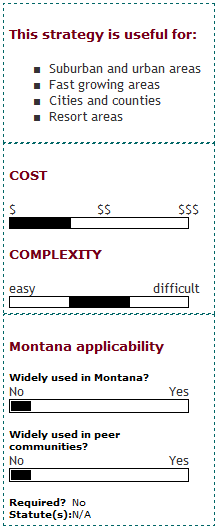
A density bonus is an incentive-based tool that permits developers to increase the maximum allowable development on a property in exchange for helping the community achieve public policy goals. Increasing development density allows a developer to increase his or her return on investment by adding more commercial square footage and/or residential units to a project. This tool works best in areas where growth pressures are strong and land availability is limited, or when incentives for attaining the goals outweigh alternative development options.
Who can implement a density bonus?
The tool is generally used at the municipal level but could be used at a larger scale if issues of tax base and service delivery can be solved. It is best to coordinate density bonus programs as part of a regional planning process to ensure a standard approach across jurisdictions. Density bonus programs must be codified by each community.
Developers who wish to apply for a density bonus begin by meeting with municipal staff to determine if their proposal will qualify for the program. Staff will review the site plan to ensure that the granting of the bonus will not adversely affect adjacent properties in the zoning district and that infrastructure and public services are available to serve the additional units or businesses.
What are the keys to success and potential pitfalls?
Market Conditions: The feasibility of density bonus programs, like many other development incentives, depends on buy-in from developers. In order to realize a return on their investment from the increased density, market analyses must show that the additional density will be economically successful. For example, it does not make sense to invest in additional housing density if there is not enough demand for housing to support it.
Identification of public benefits for density bonus program: Additional density is a highly valuable commodity. Most density bonuses are provided to a developer in exchange for public benefits, such as affordable housing, transportation infrastructure, public parks, or plazas. The public benefits that will be required in exchange for density bonuses should be tied to local goals and priced so that both the developer and the public will benefit from such an exchange.
Linkage of density with appropriate transportation and land use: Higher densities are most appropriate in areas where transportation infrastructure and mixed land uses are in place to support the higher volume of people. For example, walkable districts with transit service and local retail can more easily absorb higher densities than purely auto-oriented locations, and in turn, higher densities help to support higher levels of transit service and local commercial development.
Stakeholder Outreach and Public Education: One key to success is to ensure that potential participants in a density bonus program understand how they can earn approval for their development. It is important that outreach and education are used to generate support for appropriate densities in the right locations. Providing visual examples of well-designed higher-density projects or providing examples of the public benefits that will be provided in exchange for density bonuses are relatively easy method for generating such support. The cost of a good public education campaign will be well repaid when the tool is codified and applied.
Where has this strategy been applied?
Examples in Montana
- Hebgen Lake: The rural area of Hebgen Lake near Yellowstone is exploring density bonuses as a tool to improve protections for both wildlife and land values. Some zoning strictly limits the density of new subdivisions in rural agricultural areas to as little as one house per square mile. The district maintains current densities, but eliminates minimum lot sizes in order to encourage clusters of residential units on less acreage. To further encourage clustering, density bonuses are granted to developers who protect sensitive lands. The concept is simple - the pattern of development is at least as important as the number of homes.
Examples outside of Montana
- Citrus County, FL Access Plan: An example outside of Montana is Citrus County, Florida, which awards an increase in the density and intensity of development permitted on lots of record that eliminate existing access points or to developers that dedicate cross access easements that eliminate additional access to U.S. 19. An access point or median opening that does not comply with the Access Plan may be labeled as an "Interim Access." Under this designation, the interim access point is eliminated or altered at the developer's cost at the time the property is capable of being served by an alternate means of access.
Case studies
How can I get started?
An economic analysis should first be conducted to determine if density bonuses are feasible, and if so, to determine the most appropriate locations and the amount of additional density that could be supported by the market. Density bonuses should be targeted not only to locations where they are economically feasible, but to places where additional density would be complementary to existing or planned transportation facilities and land uses. Planning staff will need to work with developers, the public, and politicians to provide general outreach and education on the density bonus program and to design the specific policies for the provision of density bonuses and the public benefits that will be required in return for the bonuses. These policies then can be codified in local development ordinances and regulations.
Where can I get more information?
- Wisconsin Comprehensive Planning Implementation Guide Toolkit, chapter 3. This toolkit reviews TDRs and density bonus tools used in Wisconsin and elsewhere to help shape land use and transportation development. Several fact sheets of commonly used implementation tools are especially relevant.
- TDRs
- Density Bonus